

 Screw Compressor Servicing
 Piston Compressor Servicing
 Airline Installations
 1b – Detroit (235)
 1c – Complete Air Ends (224)
 2b – Detroit (219)
 2c – Replacement Pumps (217)
 2d – Piston Ring Sets (212)
 3b – Compair (222)
 4a – Refrigerant Dryers (237)
 4b – Air Receivers (236)
 4c – Automatic Drains (218)
 4d – Cyclonic Water Separators (243)
 4e – Line Filters (239)
 4f – Oil Water Separators (245)
 5a – Air Filters (201)
 5b – Oil Filters (202)
 5c – Air Oil Separators (203)
 5e – Intake Unloader Valves (221)
 6a – Drive Belts (204)
 6b – Filter Lubricator Regulators (210)
 6d – Pressure Gauges (207)
 6e – Non-Return Valves (208)
 6h – Safety Valves (206)
 7b – Inverters (241)
 7c – Controllers (220)
 7d – Sensors (226)
 8d – Galvanised Fittings (231)
 8e – Valves and Drains (209)
Your Guide to what an Air Oil Separator is and how it works
Definition – The air oil separator is a filter like part which separates the oil from the compressed air.
Function – During compression oil is injected to lubricate, seal and absorb the heat of compression, then what comes out of the compressor element is a mixture of compressed air and oil. The oil separator separates the oil from the air as the oil needs to stay inside the compressor to keep it lubricated while the compressed air needs to exist the compressor, free of oil.
Figure 1.1
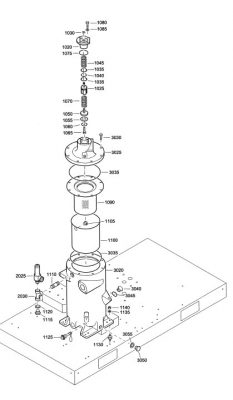
In figure 1.1, we see how the oil separator is installed into the separator vessel.
Part 1090 – Is the separator | Part 1100 – Is the splash screen
The separator is fitted into the splash screen which prevents the incoming air-oil mixture from directly hitting the separator filter.
Characteristics of an Oil separator
Oil separator can be short and most of the time they are longer (compared to the width)
On smaller machines and with certain manufacturers the separator filter can look exactly like an oil filter but only bigger. It can also screw on like an oil filter.
Location
Oil separator filter is installed inside the oil separator vessel.
Refer to figure 1.1 | Part 1090 – Is the oil separator | Part 3020 – Is the oil separator vessel
How an Air Oil separator works
Most of the oil is separated by a centrifugal force. The air-oil mixture enters the separator vessel at an angle so most of the oil is pushed outside and drops down into the oil vessel. Usually, there is a splash plate installed that prevents the air-oil mixture from hitting the separator filter directly, 85% of the oil is separated this way. The remaining 15% exists the compressed air as small droplets and mist. As this oily compressed air flows through the separator filter, the small droplets combine and form large drops until they fall and collect at the bottom of the separator filter, this oil is then sucked up and removed by the scavenge line.
Basic checks when you have oil carryover problems and suspect it is the oil separator
- Should there be a lot of oil inside the oil separator, then the scavenge line is faulty.
- Should the oil level at the base of the element be higher than five centimetres this will indicate that the separator is starting to saturate, meaning that the filter media is filling up with oil.
- Should the separator feel heavy, looks dark in colour and saturated from the bottom to the top then it is really time to replace the oil separator.
- This can only be measured when the compressor is running loaded, the differential pressure can be checked and should not be above 0.2 to 0.3 bar under load.
The above points can only be checked when the oil separator is removed from the separator vessel.
How to repair or replace an oil separator
-
Open the separator vessel and replace the separator filter.
- Ensure the new filter is the same size as the old one, should it be longer or shorter be sure to adjust the length of the scavenge pipe.
- Ensure to use provided gaskets, as these contain a mental conductor, this prevents static electricity from building up in the separator, which could cause sparks, which could also lead to a separator vessel
explosion .
About Field Air Compressors
Field Air compressors (Pty) Ltd. Was officially established in 1992. We are a company based on family values with over 20-years’ experience in the compressed air industry. We offer many products, specializing in air compressors of most brands. We offer servicing, maintenance, and spares for all types of compressors, as well as hire out units as required. We distribute Chicago Pneumatic Air compressors and air tools. Our sales team offer friendly service and we have an experienced technical team to offer you any technical advice when required.